From El Salvador to AIPC: Yanci Rea’s journey of healing, learning and giving back

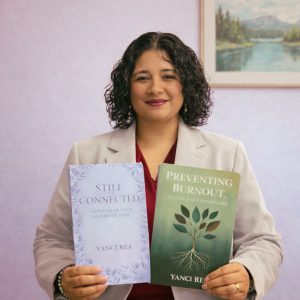
When Yanci Rea arrived in Australia from El Salvador at fourteen years old, she carried very little English and a great deal of uncertainty. Three decades later, she has completed a Bachelor of Counselling, is finishing her Master’s degree, published a book for counsellors, created a companion journal and begun counselling women through a community organisation. All of it sits well outside what she once imagined her life would look like.
“I didn’t feel good enough to go to university,” she says. “My self-esteem wasn’t very good at the time. AIPC gave me that opportunity. They gave me the confidence that I could actually become someone.”
A new country, a new language, an old fear
School in Australia left Yanci feeling like she was on the outside looking in. “A lot of the times at school, I felt like maybe I wasn’t going to be able to succeed in life.” That thought stayed with her quietly for years.
It took a painful divorce to shift things. Her doctor suggested counselling. She went, reluctantly. And her counsellor, noticing Yanci’s instinct for empathy, asked a question that changed everything: had she ever thought about studying, or doing something beyond being a mum?
“She just left it there. But it was powerful enough for me to walk away and think, maybe I should look into it.”
Finding AIPC, finding a voice
Yanci enrolled in AIPC’s Bachelor of Counselling unsure what to expect. She had never seen herself as academic. The reading and writing felt daunting.
What she found surprised her.
“Coming from a place where I didn’t speak English well enough, they supported me in that respect. I was really happy to find a place where I can feel like I can do something, I can become someone.”
Tutors helped her understand how to structure assessments, write introductions and engage academically. Step by step, a perceived weakness became a real skill. She also had personal motivation close to home: her son was struggling to believe in his own abilities and her daughter was in Year 11. “I just wanted to prove to them that it doesn’t matter how old you are, you can always study and find something to do.”
When study becomes healing
Counselling study has a way of surfacing things. Yanci had come from a relationship marked by domestic violence. Studying grief and loss, she found herself navigating her own.
At first she resisted the vulnerability. She had an idea that a counsellor-in-training should be unmoved, professional, unaffected.
“I went through a time when I used to think, oh, I’m a counsellor, I shouldn’t feel anything. But I learned to realise that that’s what makes us good counsellors. When you have your vulnerabilities out and you can see that you do have some triggers, that you are human.”
She also came to believe that suggesting a tool to a client requires having tried it yourself. “I wanted to be the one experiencing everything firsthand to see how this works and to see how this is going to take me to a better place.”
The book that came from journalling
During her studies, Yanci kept writing things down. Questions, doubts, passages from articles, stories from other counsellors. Publishing it was never the plan. Then she noticed a pattern.
“I thought, I could turn these into a book that can actually help counsellors in their journey. What I wish for me to have is what I’ve sort of put into the book for other counsellors to use.”
The result is a focused, practical guide on preventing counsellor burnout, rather than managing it once it arrives. Inspired by her own experience as a student, Yanci wanted to create a resource for other students and emerging counsellors that offered steady, practical support during the moments they may feel overwhelmed.
Deliberately short at eight chapters, it covers self-care routines, setting boundaries, recognising early warning signs, the value of peer support and how to use technology and AI as tools for well-being rather than sources of anxiety.
“My guide is more to look at the small symptoms that can cause burnout and be aware of that. Because when you’re there, it’s just hard.”
A companion journal is also finished and awaiting publication. Designed to be reused, it invites readers to write, reflect, return a year later and see their own growth on the page. “You can see the difference, the growth that you have through the journey of being a counsellor.”
Counselling in practice
Today Yanci runs her own private practice, Time Para Me Counselling, where she provides counselling to individuals and families. She’s also contracted by the Women’s National Recovery Network, an organization founded by fellow AIPC graduate Monica Kennedy, where she provides counselling support to women aged 45 and over. “When Monica approached me and offered the opportunity to partner with their organisation, I felt genuinely honoured and humbled. Their mission, values, and the heart behind their work align so strongly with what I want to contribute to the community, so collaborating with them has been a pleasure”. Fluent in Spanish, Yanci also enjoys supporting clients who are navigating both language and life transitions.
Her philosophy is clear: the tools belong to the client.
“All we counsellors do is we provide the tools and we say to them, here, this is what you have. What can you make with
those tools? And when you see them putting those tools into practice, that can be so rewarding.”
The moment she values most is the goodbye, rather than the ongoing appointment. “I want to hear, thank you for your help. I can do this now.”
A message for students studying in their second language
Before the interview ended, Yanci circled back to something she felt strongly about.
She knows what it feels like to sit in a classroom and wonder if your English is too broken, your background too different, your starting point too far behind.
She lived that. And she wants anyone carrying that same weight to hear something clearly: those thoughts are lying to you.
“If they’re experiencing that feeling of ‘I’m not good at this, I don’t understand, my English is not good enough’, turn those negative thoughts around and say, no, I am capable. I can do this. I’ve gone this far, so I can continue on. Not to be too self-critical, because anything, anything is possible.”
She is open to being contacted by students who need someone in their corner while they build that belief themselves. “I’ve been there and I know what it’s like. It’s important to have some kind of mentor, someone to cheer you up on the side when you’re feeling like you can’t do it yourself.”
Legacy
When asked what legacy she hopes to leave, Yanci doesn’t think about career milestones or achievements. Instead, she thinks about the generations who will come after her.
“I’m hoping that what I’m leaving will be inspiring for those great-grandkids that I might not be able to see. But they will be able to know me through my writing and know, oh, this is my great-great-grandmother, and she said this.”
More books are coming. Writing has become her hobby, her way of making sense of things and her way of leaving something behind. “There’s always something to write about and to talk about.”
About Yanci Rea
Yanci Rea is a Bachelor of Counselling graduate and Master’s candidate at the Australian Institute of Professional Counsellors. She is the author of a counsellor burnout prevention guide and a companion journal (forthcoming). Her work has been published in the Australian Counselling Association June issue. She currently provides bilingual counselling services in English and Spanish through the Women’s National Recovery Network.
Website: https://www.TimeParaMe.com.au
Facebook: https://www.facebook.com/TimeParaMe
Instagram: https://www.instagram.com/yancirea/